10
Aug

The Great Lesson VIII – I’m going crazy

This time around I am not going to start with the first part of my notes (which I do chronologically) and end with the final notes but reverse my order. As a result of going A->Z I’ve probably given a lot more attention to Yarostan’s letters rather than Sophia’s.

Around the time I was learning from Letters of Insurgents I was reading a lot of other things. For around an 8 month period when I was absorbing the book I was reading about a book every day. I was working in a graveyard job and living my van in Ann Arbor. I was using this as an opportunity to raid bookstores in the area, the U of M library in general, and, in particular, the Labadie collection. This was my chance to hold on the original set of SI Journal and to really dig deep into the material that has shaped my life since. I’ll probably never have another intellectual period in my life as intense as this. The problem with absorbing material in an isolated vacuum (which is what I was in at that time) is that some things you get right, some things you get wrong. I enjoyed the incredible volume of material I was consuming. Later I learned that the mixture of science fiction, post-structural classics, and everything available in English from “the milieu” would garner me a decade of being called incoherent, dense, and postmodernist.

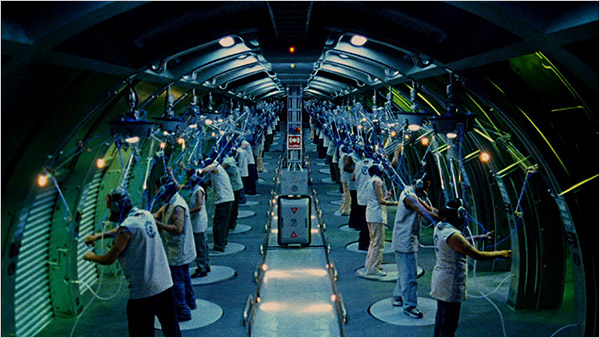
“Because I was a schizophrenic already then!” Sabina exclaims. “Or maybe that was when my schizophrenia began. I applauded because Jan had thrown a wrench into Luisa’s and Zabran’s machinery, and also because what he said made a lot of sense to me, and still does. I even understood some of the implications of what he said. During the days that followed he told me that as a boy he had lived among streams, forests and fields and had loved to explore their secrets; ever since he’d become a worker he’d been reduced to an appendage of a machine.

– Sophia 8

I am fascinated by mental illness. I’ve been around pleny of people who self-identified as having some sort of mental illness and several of my teenage friends were medicated. It’s always been a set of problems I’ve watched from a far. Even when I was digging the deepest into my own abuse history and personal suffering the way in which it manifested itself always looked like the typical self-hobbling and lack of direction that most teenagers suffer from. It did not look like Aragorn! == crazy. I didn’t quite understand how other people, people who I felt I was a lot like and who I understood pretty well experienced their pain in such different ways than me.

Reading Foucault was a lot of help. I get the idea that mental illness is socially constructed like the other invisibile tyrants of daily life. The idea that illness exists in a context1 makes sense to me and represents the kind of problematic2 that I can imagine enjoying in a time when there are no bills to pay, a world collapsing, and unchecked authoritarians running amok. I consider this analysis as useful as the other lever ideologies like Marxism, Anarchism, et al. True but not a great deal of help in helping me come to terms with survival, self possession and an action plan.

Here “Anti-Oedipus” was instrumental. I like Delueze as an author outside of this text but the exploration that this book does around schizophrenia helped me a great deal in thinking about life in misery. The pressures of life are real. They press upon us. There are no real ways to relieve this pressure, only ways to cope with it. For me I put all the things in my life that press upon me and I put them into boxes. I establish a great deal of time coming up with rules around each box. I keep tools separate from people. Work away from projects that have meaning to me. I am a functioning schizophrenic, but it is not an illness, it is survival by other means.

There was never any reason to repress anything I was doing. I’ve never been free. Free human beings can’t be repressed; they have to be destroyed.

The harshest criticism of this book is of me and those around me. We have devoted ourselves to a mythology. To revolution. To destroying all the things that destroy us. To a life long pursuit of knowledge and context and meaning. In this struggle we have not become free human beings. Or perhaps we have been free and have been destroyed. In our shattered state we have to feel our way along. We understand complexity and it hasn’t saved us. It has made us observers of life and inept at free action. The falsehood of the theory vs action critique isn’t that action (or theory) is better but that neither are sufficient.

I don’t agree with your friend Clesec’s suggestion that nothing at all changes when the workers themselves take charge of the existing production apparatus. But I do agree that such an act does not create a new form of human activity, since what is appropriated is precisely the old activity, the existing world. And this existing world is not a field for the realization of projects, but a negation of the very possibility of projects. It is not this activity, even if appropriated and managed by us, that we’re glimpsing on the horizon because it is at the very center of our present lives. It is what surrounds us now, what we inherited. It wasn’t projected by us but by the history of capital.

1. The context of social pressure to be normal, Western medicines biases, and the social scene around the identity of mental illness.
2. I can’t stand the word problematic. The problematic of problematic is pretty fucking problematic.

3
Aug

The Great Lesson VII – Criticism of letter 7

I find the back and forth about who really loved who or who loved an apparition instead of the person tiresome. The flatness of Perlman’s character development is apparent here and I don’t love Letters of Insurgents because the characters are plausible. I love Letters of Insurgents because of the way that the ideas are validated by the characters and situations in the book. I don’t think a more skilled novelist would have made Letters of Insurgents a better book. They would have made a different book with different emphasis, different political bias (of course), and different themes. They would have made a better story but it would have had flattened the sophisticated political problems that I, and most of my peers, have experienced. This lack of character development isn’t the biggest problem I have with the book.

The concern I have with the presentation of Letters of Insurgents is that it is entirely played straight. It loses touch with what I consider to be the first rule of politics. Have a sense of humor about everything you do, especially a desire to change the world. Perhaps this first principle outs me as either an anarchist or a counter revolutionary but fuck it. Political people (by any definition) who take themselves seriously are at the heart of the misery of the 20th century. They are the keepers of the flame of our future misery and should be confronted, with merriment and absurdity, at every turn.

Why do I draw such a linkage between humor and radical politics? Perhaps I see people at their best as imaginative creatures. As passionate about their projectuality as the people they love. I imagine, to the extent to which they aren’t just walking carcasses, that people have the capacity to be creators, destroyers, builders, and story tellers. Time without property or rule would be filled with stories and projects on the scale of people. No more pyramids build for the vanity of pharaohs. Imagination is generative. It is not consumed through use nor finite. Unlike the scarcity of economic thinking, social engineering, and urban planning, imagination is affirmative. Ribaldry, Irony, Sarcasm, Play would join their natural allies Story, Modeling, and Song as the flavors of daily life. Every day a feast!

I’ll restate the question and answer. Radical politics is the expressed desire, and possible plan, to transform society at its root. To tear down the fundamental characteristics of a social body and rebuild them again with an entirely different set of fundamentals. To take such an absurd idea seriously, as something that should be considered beyond a polite dinner conversation, takes a certain kind of personality. I call this person a dreamer but perhaps fanatic, fool, and monster can be just as accurate descriptions. To want such a dramatic thing, to devote one’s life to such a thing, requires a kind of extremism regardless of the exact term we use to describe it. To maintain such extremism one must create the internal mechanisms by which their (human) needs can still be met while their (political) desires are not met (or even approached). This often, perhaps usually, creates humorless creatures. You see them at protests against the horrors of this world wearing faces of intense sadness. They are fighting the good fight, on the long march, but are sickly, unhappy, tortured creatures. I apologize for standing in such judgment of this kind of honest approach but I can’t favor one form of self-torture over another. Politics as obligation, to observe horror, to protest ineffectively, to state the obvious loudly, isn’t qualitatively different to me than a life of suburban consumerism, daily commutes to soulless workplaces, and nuclear family mediocrity. All of these choices are the honest survivals mechanisms by possibly good people who aren’t sparks. They are not igniters, of passion, of change, or of bridges.

But the sadness of humorless people is not the reason for the necessity of a sense of humor in radicals. Humor isn’t a central characteristic of the humane project of social transformation because it is warm and cuddly but because it is impossible. Radical social change is absolutely and entirely impossible. The reason why this is so is a laundry list a mile long and a league wide. Embarking on such an endeavor is more than enough to demonstrate insanity (in the Einsteinian sense of the term) and the only way to survive insanity is to laugh at it. Laugh at the conditions you are in, laugh at the feeble attempts we are capable of making against them, laugh at our hubris for doing them anyway, laugh at ourselves for believing that a life without compromise is the life worth living.

This laughter does not ring out in the pages on dancing, or in any of the explication of occupations or factory takeovers. It should, because as any participant in any of those things knows, the joy of a strike or an orgy is expressed in laughter or not at all.

27
Jul

The Great Lesson – VI

A review is in order.
I read Letters of Insurgents as a great work on how to do criticism: a humane story about two sharp people cutting each other to size in appropriate, if harsh and perhaps mean-at-times, ways. This criticism ranges far beyond the tome of Letters of Insurgents or the dynamics between two writers on either side of the Berlin Wall. Each of us is confronted with a great isolation in modern society that we are unable to speak to or from due to lack of tools, models, or closeness to others. The critical model provided by Letters of Insurgents has been personally influential in its demonstration of each of these elements. In the first few weeks the focus was on criticism (by which I also mean closeness). Now we are discussing the tools and models by which we could break down the colossus of the existing order.

Y6 begins with a firm rejection against S5′s expression of love.

all that is gold does not glitter

love

I’m embarrassed by your declarations of your love for me. I can’t honestly tell you that I feel or ever felt a similar emotion toward you. I failed to make this clear to you at the very beginning of our correspondence, at a time when I was nothing more to you than a one-time friend you hadn’t seen in twenty years, a stranger to whom you hadn’t yet bared the secrets of your life…

By vomiting up the repressed experiences of your life, as you so vividly put it, you set off a similar process in me, in Jasna and in Mirna, not only by your example but even more by what you brought up. We didn’t respond to your letter with our minds but with our stomachs, with everything that’s inside us.

-Y6

If you will forgive me a generous sidebar I appreciate Sophia far more in this discussion than Yarostan. This isn’t merely because I am a romantic at heart or battle the same gendered demons as Yarostan. It is because Sophia’s expression of love, even a cheap American love, is generative. It is a sign-of-life when circumstances can be terrorfying. The impulse to take the terror of existence in a reactionary direction has become the standard operating procedure for most people, which is a great tragedy. Instead, and I’ll follow Bataille here, I believe that there is an incredible abundance of energy. Life energy. Love energy. The energy to act in ways that have yet be circumscribed by the pedants and legistators of reality.

Under present conditions, everything conspires to obscure the basic movement that tends to restore wealth to its function, to gift-giving, to squandering without reciprocation. On the one hand, mechanized warfare, producing its ravages, characterizes this movement as something alien, hostile to human will. On the other hand, the raising of the standard of living is in now way represented as a requirement of luxury.

-”The Accursed Share” Georges Bataille Zone Books p 38

The process of love & vomit, expressed here, leaves both participants better for it. We don’t have a finite amount of love that once spent is used up, leaving us dessicated and passionless. Similarly there aren’t enough ways to express our disdain and disgust with… well just about everything. Both are true. Neither are enough. Nothing is enough. The rich tapestry that should be woven with acquaintences, partners, friends, and lovers has been unravelled by Abrahamic moralism and romance shaped by Victoria and Industrialism. Whats left is barely worth vomiting OR having love on.

repression today

Althougth the point is simple in this essay from Peter Gelderloos, it is salient. “Capitalism is based on cognitive dissonance, on trained self-betrayal.” This is an echo of Society of the Spectacle the sign post directing the traffic of modern radicals from historical re-enactment to something akin to a new start. But Peter’s point can also be seen in today’s headlines about failed (and never attempted) strikes, slowdowns, and even in the way that information has become a substitute for meaningful conflict (which is not to say that wikileaks isn’t fighting the good fight but that a headline is a tragic distraction from issues closer to base need). Hell, keeping to the insanity of just today’s headlines, it appears that even our own self-monitoring will soon be outsourced as paying the military wing is becoming too expensive.

“That’s all that counts in my philosophy. The strikes are only the first step; if they don’t lead to what you’re describing, they’re nothing. In a strike we only announce that we’ve had enough of this repression of life, this non-life; we express our refusal to continue being chained to machines and cowed by police. But it’s obviously not enough to announce that we’re coming to life; we have to do what we’ve announced, we have to find the nerve to live, to dance on the tomb of the repressive apparatus.”

These repulsive headlines make sense when it’s become so easy to become crushed by the apparatus of poverty and prison. When the few who step out of line (again the recent headlines around the Oscar Grant verdict protests come to mind) are vilified as some sort of paramilitary agent of chaos when all “we” want is a “community response” led by politicians and other agents of order. None of this has changed since the writing of Letters of Insurgents when Detroit was still in shock (from which it has never recovered) from the riots of 1967. The neighborhood at the center of counter-cultural life for Letters of Insurgents (and the office of Fifth Estate for many years) was the Cass Corridor which was literally chopped in half by the insertion of freeway 10 after the riots, arguably to sever the counter-cultural area from the major housing projects on the west side of the freeway. What is true in Detroit is true in Oakland.

the devil

Mirna tells a story about her relationship with the devil that is likely to resonate with most readers. The part of the story that I enjoy is the richness of the mythological framework. It is a classic one (devils playing a leading role in most monotheistic religions), that is in high contrast to the needs of industrialized society and that continues to resonate far beyond its expiration date. We still sing of devils, dress as devils and, at least in the west, have a pretty clear understanding of what the devil is capable of and interested in.

“My whole life’s meaning is built out of such coincidences!” Mirna snaps, and then proceeds to silence me definitively. “Marbles experience coincidences, Yarostan. People experience meanings. Don’t you know the difference? I knew what I had done, and so did the boy. He was terrified; death itself couldn’t have frightened him more than I did. He avoided me as if I carried the plague. Not because of what I’d done to him in the clearing but because of what we had both done to his father. If he were here now I’d make you ask him! His fear made me afraid, afraid of myself, afraid of that devil’s sword my mother had already seen in my hand.

-Y6

We suffer for not having other rich mythological frameworks like this one. We suffer for having belief systems that only range the desert between Darwin, Marx, Smith, and Jesus. I would rather hear talk of 9/11 conspiracy than the glory of the light of jesus or the truth of evolution. I fear the lack of new religions more than I fear the belief in things that aren’t true. Truth is not at issue regardless of protests to the contrary. Money isn’t real and yet we are ruled by it. Government isn’t real and yet we march in line to its calls. The devil is as real as all of that and I am entirely sympathetic to Mirna’s relationship to it. It is the relationship that we develop to these ideas that provide them form, and spectacular reality still trumps the world of pixies, hobbits, and dancing robots with laser beams.

the primitivist and the theorist

S5 includes some of the most common caricatures in radical circles. They are humorous but slow-moving targets.

Watch where you step; he doesn’t use the bathroom if he can avoid it; Civilization destroys Nature’s cycles and all that. But he’s afraid he’ll get lost if he leaves the path. I walked him up and down the path the first time we visited him, when I realized he hadn’t left the house since we’d taken him to paradise.”

The hermit sitting on a rock was unrecognizable to me. He was as “abandoned” as the forest surrounding the lake. Hair hung down to his chest, his face was covered by a filthy beard. As we approached him, my heart pounded and my brain incessantly repeated one and the same question: am I responsible for this?

-S6

At first I found him altogether incomprehensible; he uses expressions like “desublimation of eros” and “supersession of alienated being” as if they were part of everyday language. Gradually I realized he was merely expressing my own goals with a language he’d borrowed from a newer radical literature than the one I had read. I shouldn’t say “my own goals” so matter-of-factly, since that makes me seem terribly wise while it makes him seem unoriginal. He does express several things that are new to me. For example, he doesn’t only talk about putting an end to coercion, to external, physical repression, but also to internal coercion, self-repression, the repression of one’s own desires. Yet his behavior conflicts with everything he says about desires; he’s a perfectly proper, completely serious young man; I actually doubt that he’s ever personally experienced the desires he describes at such great length. Once I asked him if he ever thought of sex. He answered, “Obviously; erotic play will occupy a central place in the disalienated gemeinschaft.”

-S6

As entertaining as these sweeping-generalizations-made-personal are they do point towards a strong ambivalence by Perlman towards models and modeling behavior in any way other than with hostility. Whether it is a lover, believer, politician, scientist, or ideologue the lesson from Letters of Insurgents continues to be a thousand “No!’s” for every yes. A great lesson but one that demonstrates the break between a kind of possibility envisioned by Letters of Insurgents and what most of us experience as possible in our daily lives.

18
Jul

Letter of Insurgents: The Great Lesson V

This is the first chapter of the book that I have re-read in the book itself. Times have changed for me and now I spend 80% of my waking hours in front of a screen and so it is just more convenient for me to read the wonderful version of the text that we put together at The Anarchist Library (I helped do the OCR work for this text using the scans that the Insurgent Summer people provided me). Reading the book makes a big difference: I am so much more likely to skim when I read on the screen and I just enjoy reading lengthy material much less. I still love the feel of paper on my eyes and when I read for pleasure it will be with paper.

Either way, though, my instincts in sharing my reading with the book is the same, which is a little surprising to me. While reading on the screen, I grab chunks of text to blockquote on the themes in a letter; when I read the book I use little post-it notes and written notes to develop the themes I want to cover. In both cases I am dealing with the fact that I don’t have enough time, hours in the day, hours to work on this, to put together my full thinking on the topics at hand when I actually have them. Instead I am recreating my reading thoughts during my writing time. They are fragmented by function… but I have spent so much time on this particular text it might not be as severe as it would be normally.

If I get the time (at the end) I am also going to try to finish, housekeeping style, a couple of the remaining themes I wanted to talk about in letters 2. Actually the themes of the good life (of a politician) and generosity will probably be woven into this set of thematic discussions pretty easily since Yarostan develops this pretty clearly here.

Work

Y5 (that is Yarostan letter 5) is a strong argument against the institution of work. It is a criticism of the role of the knowledge worker in particular, and predates a body of work around these topics while maintaining a human touch around the topic. Bob Black (in)famously wrote an essay (which was also a presentation as provocation) called “The Abolition of Work”. While the author (and other people with a certain kind of fixation) might take the article as a literal argument against work, its real power is in asking orthogonal questions about the nature of labor and the project of Marxists who valorize labor itself, beyond any recognition of the (cough) use-value of the product of labor. The pro-work ideology is to assume work first of all–before the product of the work, before the worker, and before the impact (environmental, social, psychological, etc) of that work. And the reactions to the Abolition of Work gave this thesis more energy than it probably should have had.

Bob Black (like the post-left anarchist milieu he represents in many people’s eyes) took ideas that had been floating around in certain European anti-state communist circles and synthesized them into a kind of popular (as in easier-to-digest) form for the American audience. While recent post-left theory has been a bit of a Return-to-Stirner the idea of post-left anarchism has drawn heavily on the themes of the Situationists, Councilists, and even Bordigists. This idea of of opposing the institution of Work has roots in the critique of Marx’s project of universalizing humans as workers.

But Y5 isn’t concerned with making the critical argument as much as sussing out, as in talking through, the difficult question of how do we live (where living means being a rent-paying, commodity-purchasing, alienated consumer) while having issue with the consequences of what living means.

The tenacity with which you pursued your struggle, even in the face of certain repression, is something you share with Jan, not with people we both consider opportunists. Your recent confrontation with the administrative psychologist at your college, your exposures of militarism during your university years, your disruption of the war expert’s class, are clearly not opportunistic acts, and you make it perfectly clear to me that you couldn’t have derived any privileges from engaging in those acts. You’re right when you accuse me of failing to distinguish your commitment from the commitments of those around you. I did accuse you of being a carrier of the repressive fuctions of the university and the press and I recognize that this accusation was unfair. I did identify your engagements with engagements that are as unacceptable to you as they are to me. I think I did this because the contexts in which you’ve chosen to struggle are contexts in which I had thought genuine rebellion impossible. In my world the political militant, the journalist and the academician do not and cannot help establish a human community because their very existence presupposes the absence of community.

– Yarostan 5

There are two lines here that I think are worth following through, and they aren’t as clear as an argument between Y5 and S4. One line is that ideological jobs, ones that require you to “believe in” something (rather than just punching in, following orders, and punching out) are somehow impossible places for a human community. The other is the hard question about identity and work. If where we work, the kind of work we do, our qualitative ability to do that work is at all connected to our ability to organize ourselves as a fighting force against the existing regime… then we are going to have to believe in our work, whether it is as a knowledge worker or as an industrial proletariat.

Both of these lines lead me, as someone who has been influenced by the anti-work ideas presented earlier, to understand that personal happiness and a strategy toward general liberation have problematized Marxist categories and libertarian desires. Instead of Either/or we are now faced with Neither/nor.

But of course Yarostan is wrong. It is possible to develop something that subjectively feels like a human community just about anywhere. He makes the case that it is possible in prison, S4 makes the case that it is possible in the knowledge factory, a dozen Russian novelists (and a thousand stories about the Holocaust) make the case that moments of horrible repression and terror are also moments of great human kindness and community. But obviously this fragmentation, the very partialness of the kind of community that is possible in these places is what Yarostan is lamenting. It is what all radicals lament as they struggle for another way of living. How can a people (us!) who have never been free find our way toward freedom? How can those of us who have never been a part of a human community form one?

The strategic question remains important. The classic Marxist equation here is that the sociological group that has any characteristics of a rival to the military, entrenched bureaucracy, and political & financial elites are working people. Working people have more similarity with each other than with the other groups, we have the power to dictate terms in a society that requires them, and we have the potential to be self-aware (as a class) in a way that these other groups already are. Plus, numerically and categorically, working people dwarf all of these other groups combined.

Study after study has shown the power of working people, as expressed by unions and formal organization, has been on a deep decline for more than a generation. Whatever victories were won by workers organization in the West has collapsed. Apparent to any liberation, worker organization outside the west collapsed from within and lies in ruins today. If the rhetoric is to be believed, the kind of work represented by unions by what is called the proletarians is in steep decline (because obviously China doesn’t exist), which makes impossible the General Strike kind of social change that the Left relies on.

Corruption

When Fredy was writing Letters of Insurgents and contrasting the East’s and West’s view of work, as ideology and vehicle for social change, it is no surprise that he would develop a storyline around corruption and nepotism.

There is still a mythology about the Communist regimes that they are (and were) rife with the kind of corruption based on (familial & social) relationships that deeply rankle the competitive meritocratic American psyche. This is a myth about competing ideologies where the West is vigorous and self-correcting because every generation and every individual must prove their mettle as opposed to the lazy bureaucratic groupthink of the Communist regime. We are the beneficiaries of Ayn Rand without being assholes and they are a cross between Squealer and Napolean from Animal Farm.

Vera’s remedy follows from her own diagnosis: the system has to be cured. How? “We must find … We must create … We stand … Let us…” “We” of course means Vera Krena together with her audience, Vera together with the working population. And how will “we” cure the system “together”? Obviously the same way “we” have always done anything “together.” We the workers will do our share by remaining at our posts in the factories, while Vera will do her share by remaining at her posts in the offices of the academic and ideological establishments. In other words, we will cure the system “together” by continuing to reproduce it.

– Yarostan 5

When confronted with radical statements like “wage slavery must be abolished” or “we must smash capitalism” it is very easy to consider the speaker shallow or impossibly naive. Generally when people are inspired by rhetoric along these lines, it is before they have realized the multi-dimensionality of our repression–especially as it graphs to the ways in which we repress ourself. But the abandonment of the “high concept” of naming a complex enemy and working against it also tends to tame one’s conflictual perspective all together. If our enemy is intractable it is, perhaps, better to abandon conflicts that can be stated as simply as “us and them”…

But the struggle against this is actually very simple (if abstract). It just means ending your participation in its reproduction. A system that cannot reproduce itself dies from lack of interest in a generation or so.

Obviously such a simplistic statement is just moving the abstraction from destroying or abolishing to reproducing but I think there are specific ways that we can talk about the reproduction of the ideological apparatus that includes certain kinds of career choices, pastimes, political activities, and hobbies. I disagree with many radicals who would argue that “the best” way not to reproduce the system is to entirely drop out of it. I understand the impulse and I think it benefits individuals to try “dropping out” but I believe it is, ultimately, limiting because it speaks to the impulse of scarcity and constraint (specifically self-scarcity and self-constraint) which as expressions of Christian moralism have a historical dialectical waveform. Ascetics are seen, in this culture, as either compromised OR as intolerable (or both).

I think that reproduction can be discussed (if not measured) to the extent to which it increases ideological shifts (for instance toward participation in the Information (aka Global) Economy rather than one of human scale) toward hierarchical power. Reproduction exists in participation in the political, military, and policing apparatus (although clearly there are levels). Education, Finance, social work, and participation in NGOs reproduce this system. Most everything else, from electricians, service workers, and what’s left of the industrial working class do not.

I am reticent to give such specific examples, by the way, even as they are so clearly parallel to Yarostan’s. While I have been influenced by this book to a great extent, even to the extent of how I chose my own career, I recognize the great privilege of making such a choice. I did not read this book after having devoted ten years of my life towards getting an advanced degree that I could only apply to a “reproduction job”. While I have judgment of the set of choices one makes to put themselves in that position I am entirely sympathetic to how one would find oneself in that situation. I read this book before it was too late. I was ready for the message of what I’ll call engagement AND disengagement and against reproduction. In my own way (that ended up being a lonelier way than I anticipated) I made my choice and suffer the consequences.

Proper revolt

This is a great time (temporally and in the book) to muse a little bit about the proper way (form and practice) to revolt…

Where was Luisa when revolutionaries like Manuel were swept out of the way? Was she alongside the aspiring foreman Alberts, helping to sweep people like Ron, myself, Manuel and Jan out of the way? She virtually admitted this when she said that “such people” were a greater threat to the revolution than the militarists. I’d really like to know where Luisa stood during this purge of saboteurs. I’ve long ago become suspicious of her interpretations; your letters have made me wonder about her activity as well.

– Y5 (p 311)

On the west coast we recently had visitors from Greece. Greece has lately become a bit of a magic word on the lips of anarchists, one spoken as a place and as an incredible series of actions over the past 2-5-10 years. Greece proves that anarchists have some traction somewhere and that certain kinds of passion are expressed somewhere. The visit was great and all but there wasn’t enough of a sharing of how the theoretical and activity development could happen in Greece when it so clearly has not happened in the rest of the West. Let’s save that for another time.

One topic that the Greeks did cover fairly well was their insistence on using certain terminology to describe their activity that varies from ours or what we would call the standard way such activity should be described. Specifically they call their efforts against the system (State & Capitalism) as struggle rather than as resistance. This distinction is important as a way to place their (our) activity as proactive and willful rather than the action of resentiment or reaction. There is a kind of conservatism that you see often with Leftists that argues that whatever “they” do is bad and we should be against it (trite example: we should resist the G20) rather than that our struggle for freedom includes particular attention toward the cabal of global leaders and their machinations.

The past few months and events in Toronto and Oakland have brought the issue/question of what is the proper way to revolt back into vogue. The mainstream attention on anarchists has been hot since May (when there were actions across the US) and the environment has not been conducive to the kind of self-reflection that is long since needed since ’99 (aka Seattle WTO). I am not going to speak at great length about my own thoughts here other than to say that I relate far more to the forces of smashy smashy than I do to the responsible movement builders who sound like they come right off the pages of this book as they wave their fingers in the face of “such people” while telling them how to revolt properly. This said, my friends would be better served applying their energy toward struggle rather than toward resistance against institutions that feed off of their energy. We are giving them far more by resisting them than we are gaining from the experience.

Onto Sophia 5

This is one of my least favorite of Sophia’s letters. There is a certain amount of a situational comedy element that just doesn’t speak to me. I understand being confused and making dumb decisions under stress and that being somewhat comedic but over seventy pages of Sophia’s schizophrenic behavior, and erratic thinking about it, was just disturbing. I never enjoyed watching “Three’s Company” either.

In between the confusion and drama was a peek at a couple of the Garage characters that reminded me of people I have known.

He’s one of the few people I’ve met who knew the difference between things and people and never confused the two. He can do anything that’s ever been done with a tool, but he’ll never touch a weapon, and he’ll never confuse the two. He doesn’t step on a worm if he sees it in time, and he looks sadly at a dead fly. You’re afraid of him? Sophia, believe me, the world will end before Ted attacks you. I can’t imagine his wanting to kill you or me.”

There were two important people in my life who were similar to Ted. One of them knew the difference between people and things and preferred things. The other chose people but it didn’t matter as the people in his life weren’t enough to save him.

This particular characteristic is rather common in men, in particular in the technocrats I am surrounded by. Warm, broken (hearted) men who have more skills dealing with things than people and have grown to prefer them.

My experience with these men, and my friends before, don’t give me hope in the power of individuals to overcome their gender training, the fractured social conditions that shape them, or their own good intentions overcoming survival decisions. Instead I’ve grown to appreciate the partialness, the wave form of social time together as being as likely to amplify as to flatten. The open question of when disappointment will come rather than if. I guess this is a story of cynicism but I don’t mean it to be; it’s one of the calibrations necessary to be in reality rather than Hope-instan.

“There’s nothing to understand, Sophia, and nothing to fit into. It’s your life to do with as you will. There’s no structure. Nothing is banned. Everything is allowed. No holds are barred.”

This is that hope laid bare. I have always desired this kind of freedom. This lack of restraint, freedom to action, and to love. If Sophia 5 shows us anything it is that when confronted with even the possibility of this, our this-world-socialized brains don’t know what to do. We freak out. We behave inappropriately and erratically. This is true. Sophia 5 is a true letter. I feel like I’ve seen it a hundred times.

I’m not sure I have much more to say about Sophia 5 but there are a couple more quotes in here that are worth remarking on…

“Then tell me one more thing. What do you know about that commune some students got going?” I ask.

“Nothing much,” he says. “Some wild new `cultural radicals’ have got it into their heads that they can make a revolution without the working class, inside a university building.”

“Thanks again, Daman,” I say, climbing out of his car.

“But none of my students are involved in that,” he adds, boasting.

“Because they’re the working class,” I shout.

He shouts back, “That’s right, they’re the working class. Goodbye, Sophie.

This section is particularly funny coming hot on the heels of the activity in California in the past ten monthes. If you are interested in finding out more you could do worse than checking out a little newspaper I helped publish…

After the Fall

One last quote that I’ll leave with that, even with the layers of self-deceit embedded in it, still reads like a powerful personal indictment.

“I’m discovering it with them, Sophie. I’m discovering what it means to be in a society but not of it, what it means to be insulted, excluded, maltreated and injured. I’m discovering what it means to be a stray dog with human characteristics. And I’m discovering that everything I’ve learned is as useless to them as it is to me. These are people who are becoming themselves, Sophie, on their own. It’s a process in which neither you nor I can help them, a process to which we cannot contribute, a process we can only harm. They can only help themselves and each other; they cannot be helped from outside. I’m not here in order to guide, to help, to contribute, or to interfere or meddle in any way. There’s no room here for those who are able to give but not to receive. I’m only here to learn.”

“You don’t know me, Hugh,” I said. “That’s all I want.”

“You, Sophie,” he said, “you don’t know who you are or what you want. I’ve known you to be sincere – once, perhaps twice. Always quick-witted, at times even brilliant. Brave, even heroic. A rare companion. But please believe me when I tell you I don’t need you, Sophie. My new friends don’t need you. What you carry inside you, what surrounds you, whether you intend it or not, is all the rot we’ve started to shed.”

I turned away from him and walked to the bus stop. I didn’t shout, nor tremble, nor cry. But my heart was broken.

11
Jul

The Great Lesson – Part IV

Loss and authenticity

We are past the intensely critical part of the novel and are now moving onto the great descriptive portion. Letter four is about a carton factory, a university occupation and all of the characters in Yarostan & Sophia’s life. It is about the specific nature of peoples behavior and how the consequences ripple out over time and into lives.

I’m not the same person I was twenty years ago, the person you knew. My commitment to slogans, words, programs, abstractions on signs, was a commitment to death. Twenty years ago I was the victim of a mystification. I began with vague yearnings for free activity; I began with a longing for freely chosen projects carried out within a community that made the projects possible and appreciated them.

-Yarostan (4)

what is real?

As you get older and you gain experience and, if you do it right, long term relationships with sets of people who continue to have meaning to you even as it changes. Be they rivals, people you detest, or care about. If I were to develop a time line of the last 20 years of my life since my serious involvement in radical politics it would read something like this (in order): activist, the restaurant years, the traveling years, the confused years, the house, the magazine, and today. The amazing thing, because I have stuck around, is that I still have people from each of these periods still involved in my life. Different periods are filled with more people in a certain category than others and it’s not like I am friends with most these people but they are still in my life.

I can imagine in 10 years writing a letter to an activist friend from twenty years past that sounds as much like aliens looking for a rosetta stone as these first few letters and then finding it.

I didn’t identify with Marc, Vera or Adrian and I obviously didn’t identify with Claude. If I identified with anyone in Jasna’s or your narrative it was with Jasna herself and, much as you hate my saying it. with you. I identified with you, Yarostan, not because my life was anything like yours but because I wish it had been, particularly right now. I’m genuinely overjoyed that you’re finding in your present life everything I sought but never found throughout my life: a real and significant project with people who are alive and want to be. I came close to that kind of activity only once and you’ve just about convinced me that I wasn’t close to it even then.

– Sophia (4)

This desire for authenticity is something that feels like something many radicals (current and former) leave behind during their search for self. Most of the normal people I encounter in my day to day don’t share anything even close to this kind of attitude. This sense of loss in the world that we live in. Perhaps deeply spiritual people… and some radicals.

But I want you to know that from the bottom of my heart I hope you and your friends are now creating the community I sought in every environment down to the underworld, the community I tried to invent in my novel because I never found it in my life.

– Sophia (4)

This letter to a friend would be about a human community that we passed through but had no way to make permanent. Our moment together, like the carton factory occupation, was partial, temporary, and on some level empty. Empty because we did not have to tools then, and have found a way to make due since, to make the kind of community we desired. It’s hard to describe the number of ways that this great loss has impacted us. Making even a letter like this one impossible.

1
Jul

Letter of Insurgents: The Great Lesson III

I am writing about this book again after years of absence, because of how formative the book was in my thinking about criticism (and specifically criticism as a form of communication and engagement with written material). The relationships in this story are still the model I use when considering what I mean and what I desire, when I engage in criticism with someone or some project. Criticism is the infinite pool that feeds me and the engagement I would like to have with my peers. But what I understand criticism to be, informed by this book, is very different than the way the term is used by others or practiced in the world.

Before I discovered a critical anarchist perspective (more on this terminology later) I was probably (cough) called a smart ass. Regardless of the situation, I would often question premise and presenter, which usually was at my expense. since I was not the student creating an optimal teaching experience for the teacher and alert students alike. I sat squarely in the middle, in a haze of my distaste for the mix of social interactions, control, and knowledge-without-context. I was not smart enough to have found my own way out of this mix and did not have a guide (until much later) to demonstrate how the pieces of institutional life worked together in creating an environment that priveleged certain kinds of attention and ability.

I did have humor, sharpened at the kitchen table, with which I was able to pop the balloon of pomposity and skewer the situations of ennui. It wasn’t enough to be considered truly funny (what do I look like, a clown?) or to have a lasting impact, but I had enough abundance that aligned suppressive forces were not able to exhaust it. This instinctual critical outlook hasn’t exactly served me well from either a social or logistical perspective. It has cost me many friends and has made my work life… challenging.

The relationships in Letters of Insurgents still work for me as examples of the kinds of critical relationships I would have liked to have had with my peers, but that moment is gone. We are all moving too fast and our own ability to have relationships is curtailed by our desire to avoid… ourselves? drama? patience? inhumanity? ambivalence? We have these kinds of closenesses in quiet spare moments between the maelstrom of schedules and pressure.

I wanted to get into a couple of the themes I missed from the last chapter that still have me thinking. I begin my reading of chapter 3 by way of review.

Memory, Precision, & Accuracy

I’m not. after all, competing in a memory contest, nor writing a history, nor am I engaged in scholarly research into my past… By eliminating this standard you’re left with nothing but the world as it is. If you deprive yourself of the ability to see what people can be and what life can be you’ll only be able to see what they are and you’ll conclude that’s all they can be.

– Sophia (2)

On re-reading this I am not concerned with the disingenousness of the statement but with the way that it demonstrates that we, individually, value our recollections (as data) differently than we value our interpretation of them. This statement is particularly striking in a letter that is, for all intents and purposes, a correction to Yarostan’s fierce criticism of Sophia and the project that they had together. Yarostan is talking about interpretations of an incontrovertable piece of information (very simple facts as a matter of fact). “We lost and our project has been shown wanting.”

In my social circles I am apt to making flippant comments like “there are two kinds of people, copy editors and the rest of us.” This is in reference to a kind of one part personality and one part vocational approach that some of my closest friends make towards information. The precision of the comma placement, the font choice, the punniness of a turn of phrase becomes the all consuming topic of conversation, for which there is no recourse but to wait out the quibbling and sorting out of details before a conversation can move on. The sorting out of the exact date of Franco’s crossing of a certain latitudinal axis far more important than the entire military context that this crossing occured within. The tree is actually more important, or more of a topic of fascination and compulsion, than one thousand forests.

This relates to Sophia’s letter in that she is actually exactly engaging herself in a memory contest. She is trying to win a sense of victory over her own understanding of the events that took place many year ago. Her perception is blocking her memory.

No, I’m no longer angry. I’m frustrated. For twenty years I longed to tell you about myself, if not in letters then in a novel which was addressed to you even if it never reached you. I wanted to tell you about my life because I thought I’d lived up to what you might have wanted me to be. I looked at myself through what I took to be your eyes and I wasn’t ashamed. I was in fact somewhat proud of myself. Not altogether. I hadn’t taken part in the overthrow of the ruling system. But I hadn’t succumbed to it either.

-Sophia (3)

I believe that many, if not most, of my copy editor friends suffer this particular frustration. On the one hand they have a precise understanding of the number of gravel stones they have passed to get from there to here but on the other aren’t quite sure how the path ended up being such a treacherous journey in the first place. The gravel had no impact on the elevation changes of the journey. (you will be amused that my favorite local copy editor made a note here… kiss my ass)

Perhaps this is a story about the Western conception of time. That story goes somthing like: time is a linear progression of thens to nows, past through present to future. We, as residents of this flow, start at a point and end up a little further down the way. In the greater scheme of things our journey is but a blip but it can be mapped on the greater plain of social life.

A different story is that there is only one time. Now. We live in the now and the memories or hopes that connect us to the past or future are tenuous and are related to where we are now and not what we were at another time. Two people’s very different interpretations of similar events is easier to understand when the relationship they have to former events is understood to have been to different “nows” entirely.

Perhaps the physical properties of light can provide some insight into this metaphor (which is largely what time is). Light is comprised of charecteristics of both a wave (like an ocean wave) and a particle (like a bullet moving much much faster). This dual property is why light can have both a speed and be visible to the eye. Why light can literally push on an object (see solar sails) and be amplified with refraction. Lived experience has something of a dual property where facts stream by at a pace akin to infinity and are related to us to the extent to which we can pull units of them (quantum) out into a comprehendible form . The amount and type of evaluation we perform to choose our quanta with which to measure and calculate our “us-ness” has to be mostly random and only partially willful. But perhaps this speaks to my own lack of valorization of the individual.

Nihilism

I have written about nihilism other places. 1, 2 I can be described as someone who is friendly to hopelessness and unfriendly to much of modern idealistic thought (whether in politics or philosophy). I use nihilism as a blanket term to describe these inclinations but only as tempered through the, dare I say ethical, lens of an anarchist pedegogical approach.

Many of the themes I consider important along these lines are covered by Yarostan, especially in letter 2, and they begin with this.

When the strikes and demonstrations ended, when most workers realized the carnival was over and returned to work, our group continued to perform its show. We were still printing posters, glueing “Factories to Workers” on recently cleaned walls, shouting about the workers’ commonwealth. At that point we became dangerous, because at that point people like us elsewhere saw that at least some had meant what they said and that the performance of a play had not, been the only possibility. If others didn’t realize this, at least the authorities thought they did.” Only at that point did we begin to “act on our own,” but we weren’t aware of this. We were so carried away by our performance that we failed to see that the curtain had fallen and the carnival had ended.

-Yarostan (2)

Which so clearly echoes one of my favorite definitions of nihilism by Vasily Vasilievich Rozanov that they should be considered together.

The show is over. The audience get up to leave their seats. Time to collect their coats and go home. They turn round…No more coats and no more home.

The story of the kind of revolution considered in Letters of Insurgents (a shadow puppet play still being performed today, with its echoes of the French Revolution and the idea of a complete change of the political terrain by a willful social body) is over. It is a gorgeous story that we should remember–perhaps doing annual reenactments–but the seamlessness of the existing order is unassailable. This isn’t to say it is infinite or forever but it is outside of the capacities of any sociological category to overcome. The existing order, to the extent that it exists, sees danger coming a mile away.

Moreover, to the extent that resistance to the existing order has shown itself to be successful in the short term, it is usually at a great cost. For most of us the cost is greater than, or as great as, the cost of the status quo. This makes the desire for total transformation at odds with an honest self assessment of what will be brought about by particular actions in the here-and-now.

I am falling further behind but I want to get this up and clearly I am barely done with my thoughts on chapter 2. In a few days I’ll update again and plan on then being caught up by chapter 5.

21
Jun

Letters of Insurgents: The Great Lesson II

This week’s submission is going to be a little short. I think I need to pace myself (I still have eight weeks after this one) but there are so many themes from this week’s reading that I’must dig into, including a rich quote from Sophia about memory exercises, the concept that political people have “the good life”, a famous paraphrased quotation, and the generosity of poor people. I hope to touch on them in later weeks. This week I’ll keep my focus limited to how loaded perceptions are.

In many ways, during the time it stood, the Berlin Wall, the great wall dividing the West from the Soviet regime, helped clarify life in America. We were clearly separate from them and we had a clear symbol, with armed guards and not-so-symbolic bullets helping make the distinction crystal clear. The story of Letters of Insurgents is amplified by the existence of this wall during its authorship and the real divide between the authors. Today such divides don’t seem to exist and equivalent letters would read like muffled calls out of the postmodern malaise of this time or perhaps as Romeo and Juliet type stories set around Israel, Tijuana, North and South Korea or the Taiwan Strait.

Our barriers are local at best and no longer encompass our entire existential existence… but of course they do. We are trapped by symbolic distinctions as shallow as red state versus blue state, cosmopolitan versus real (as in “real American”), etc. We suffer quietly in a kind of “unreality” where the ties that should bind us together as individuals and united groups are entirely in the hands of politicians, financial interests, and biased story tellers (aka the media). Once we had the people we worked with, the people we lived near, or the people who looked like us to organize, strategize and agitate with. Today we barely are able to figure out where we, as individual active agents, begin and end, physically, metaphysically, intellectually, etc.

This set of letters is powerful not because of the meanness of Yarostan or the defensiveness of Sophia. I don’t actually consider Yarostan to have been that mean (or Sophia that defensive). This is a set of letters about memory, interpretation, and priorities. This is the heart of the book and it is a very difficult read. Perhaps Sophia was correct in describing Yarostan’s letter as cruel but by a definition that is not common.

But this is the world. We observe the attacks made upon our bodies, and describe the shadows that attend disruptive phenomena but there is no critique as such to be made, no protest could be adequate to the continued diminution of personal life in the face of the perpetual throbbing of commodity spread. Power will do what it will, there is little (if we are consistent in our analysis) that we can do to oppose it.

-Nihilist Communism: Cruelty or the Inclusion of the Distributive Sphere

Cruelty, here, is the forcing oneself to frontally face the mirror of the consequences of our actions. To deeply understand the horror around our desire for everything good. One person’s gossip is another person’s dossier. One person’s romantic tryst is another’s life long love affair. Interpretation isn’t merely an exercise in explicating the difference between you and me but of the harsh consequences of people being completely different. It is not an exercise is equivalent truths between thoughtful, caring people but on a stage that is not controlled by us or our friends. Furthermore, this distinction exists within the context of the greatest project of all, of opposing the world of cops and salesmen and real people get chewed up. They get ground to bits.

For the sake of grounding my interpretation in the text itself I’ll pull out one major example: the questions about actors and stages.

Yet surely somewhere in your consciousness fragments of another experience must survive. An “outside force” did in fact define your project and make your decisions. It was none other than the politicians who three years earlier had helped clear away one army in order to make room for another. You and I merely recited the lines of a script, moved under the control of a puppeteer. Even the emotions we expressed were predesigned. You apparently liked your costume and make-up so well that you’ve continued to wear them after the play ended. The play was a show of the politicians’ power “among the workers”:, the plot dealt with the “workers’ struggle” against the politicians’ enemies; the climax came when the workers ousted Zagad from the factory. At that point, behind the scenes, politicians ousted Zagad’s friends from government offices; anyone unfriendly to the politicians was automatically Zagad’s friend. The union apparatus acted as puppeteer. Union politicians initiated the strikes, prepared the spontaneous demonstrations and lectured about the solidarity, power and determination of the working class. It was our role to confirm our solidarity by reciting our scripts, to demonstrate our power by gesturing and to show our determination by making faces. The play was educational: its main purpose was to instruct the audience about their lines, gestures and feelings. The feeling you still express today: the illusion of autonomy, the illusion that we were defining our own projects and making our own decisions, was precisely the illusion the play was designed to communicate.

-Yarostan (letter 2)

While this particular play may not be common in 21st century America I believe most contemporary readers can understand what is going on here. Whether it is the machinations around putting together a school play or an insurrection there are usually forces in motion with very different goals (and often goals that aren’t even clear to the forces themselves at the time). This is especially true when they use the same rhetorical conventions. If experience, both personal and historical, tells us anything it is that it is the people who actually believe the words of the chants or the the mission statement of the group who end up being manipulated and “represented” by those whose participation has entirely different motivations. On the one hand we require facility with a certain kind of vocabulary that is distinctive to our project because we believe that the language around our project contains a kind of power, on the other hand facility with jargon does not magically align interests or predict future action. Politics is greater than belief[1] and a thousand heart wrenching poems stating otherwise is only evidence.

You describe my activity with you as a puppet show. Your description corresponds neither to the events I experienced at the time nor to events I experienced later. I’m not misreading your letter. I think I understand perfectly well what you’re saying. We thought we were acting freely while in fact we were being manipulated. Therefore we were puppets. Since we’re not in fact puppets but people, we must have turned ourselves into puppets. Therefore we manipulated ourselves…

Your analysis reduces a two-dimensional picture to a single dimension, it reduces two sides to one. The protesting students were on one side, the politicians and all other officials were on the other. The fact that the university officials accepted the student politicians as the spokesmen of protesting students doesn’t mean that any of the protesting students accepted them as their spokesmen. It merely means that officials recognized and embraced other officials and momentarily disregarded their club’s age requirements. By omitting the second side you lose sight of the relation between the two sides. You leave out what we used to call the struggle between the ruling class and the repressed class, the class struggle. The fact that the rulers recruit their agents from among the repressed doesn’t mean that the repressed are the agents of their own repression.

-Sophia (letter 2)

It seems evident to me that both writers are correct and are making different points. Sophia’s argument here is that the power of autonomy and independent creative action (aka the class struggle) is the important part of the story, perhaps of life itself. If the choice is between the politician and their backers or the protester and their friends, Sophia’s choice is clear. In her analysis Yarostan is making group identification entirely negative. If one member of the working class is willing to act the role of the politician then are the working class dupes of the politician?

Yarostan argument is that the specifics, or the intentions of the actors, aren’t particularly important to the reality of the 20 years he spent in prison, or the not-positive impact they had on the situation that they were in control of, not to speak of the world outside of their factory or their relationships.

This distinction, between the fatalist and the optimist point of view, is the political heart of the story and echoes throughout the rest of the book. The way in which each of the writers bounce back and forth in subsequent letters still resonates with me as I age and am hampered from my natural hopefulness by the experience of the failure of the vast majority of my projects with living people.

12
Jun

Letters of Insurgents 1: The Great Lesson

I want to preface this by stating that I am going to speak to Letters of Insurgents with a combination of personal journal and exposition as this is both a book that is very personal to me and deserves some analysis beyond the personal.

Anyone who knows me knows that I am a very angry person. I have been and continue to be motivated by anger. During the period when I was most influenced by Western (psychology) and Other (martial arts, meditation, etc) mental healing modalities this became a concern, since there was a limit to how “healthy” I could become if I was not going to resolve the underlying anger at the root of my personality. I needed to “let it go” if I were going to become a person at peace with myself.

Suffice it to say that I resolved never to be at peace with myself or my condition. I devoted my efforts toward using that anger as motivation to continue working on projects, relationships, situations even when they were boring, irrelevant, or ridiculous. Over time I came to realize that my anger was generally not personal (not about the seeming target). It was about me and my dissatisfaction with my condition. Generally it was not related to my particular impatience or the actions of those around me at the time. Anger remained the vibration that resonated with me but was not the entire scope of my interaction with each and every person at each and every moment.

Punk rock was the perfect milieu for anger, because within punk rock anger went without question. If you were a punk (in the mid eighties) you were pissed off. You came from some variation of a shitty background and/or were so fucking intelligent that you suffered the mediocrity of public education prison life. When punk dried up (for me) it seemed like I suddenly had to justify my dissatisfaction in a way that I never did in punk. Being pissed off wasn’t considered appropriate behavior, in particular in the let’s change the world crowd. I didn’t understand this at the time and I don’t understand it today. I want to destroy the world because of the horrors that it has turned beautiful people into, because of the pain I see around me, and because of the constraints everywhere. (The desire for) social transformation does not come out of the end of an intellectual process by which I have determined the best approach by which to create the ideal form. I do not use logic to express my motivation. I use anger.

In anarchist circles this punk approach is hard to find. While you can find people dressed in the right clothes (punk, neo-punk, gothic punk, crusty punk, hardcore punk, ad nauseum) and people who come out of the “punk scene” their fashion and music tastes usually come out of a really different set of motivations than their politics. Usually these punk rockers (which I will differentiate from a punk aesthetic or value) take on anarchist politics as an expression of seriousness. “I might look like this (threatening) and use this (anarchist) word to describe my political philosophy but that actually means this (direct democracy, sharing, caring, lots of meetings, etc).” This becomes a cipher, only comprehensible through the process of participation…

I am reminded of a parable I read in a biography on Prabhupada (the founder of ISKON aka the Hare Krishnas). I found him fascinating at the time because of the fact that his rhetorical skills were, in fact, an appropriate substitute for the emptiness of his religious point of few. (This is America where every silver tongued charlatan can make a million dollars if they set their mind to it, especially if they are selling a new way to reach God…) Anyway Prabhupada is walking along the beach with a Catholic priest discussing religion. The priest remarks to Prabhupada that Prabhupada would understand the importance of the trinity and other affectations of the priest’s order if Prabhupada were only to devote all of his time/energy to the priesthood for a period of time (a couple of weeks). Prabhupada’s pithy response was that of course! All the priest had to do to understand Krishna consciousness was the same. I am reminded of this story often when I think of rhetoric as a substitute for personal growth or shared realizations.

Somewhere in here is the distinction between belief, identity, and action that I’ll probably follow up upon during the next 10 weeks as I re-read the lovely “Letters of Insurgents” with you. For the sake of this discussion Letters of Insurgents can be referred to as a central text in my life. I first read Letters of Insurgents at the “right” time in my life. It was during a period of great loneliness when I was first confronted with the dilemma of scenes and friendship circles as poor (and rich) substitutes for relationships and family. This book was my guide from a certain kind of innocence to what I have become, and in the decade and a half since then this book stands out as something that cleared the way for me.

Chapter One

I’ll try to stick to a couple of conventions throughout this reading. Chapter One refers to the back and forth exchange between Yarostan (Y) and Sophia (So), Obviously each chapter bleeds into the next but the exchange of letters is a convenient device for the division of the book. I also am keeping a growing personal biography of each character as I write this book, adding to it as each character becomes more fully developed.

My guess, after reading Artnoose’s first article is that there will be two kinds of readers of Letters of Insurgents. There will be those who identify more with Sophia’s character (and by extension with Fredy) and those who more-or-less identify equally with everybody. I fall in this second category as my personal experiences have some overlap with every major character in this book and, as a personality type, I have been fully committed (for better AND worse) to each of the decisions as I made them. I have tended not to worry much (especially when I was younger) about the consequences of my behavior. Perhaps more accurately “worrying” wouldn’t be the best description of how I contemplate activity. Perhaps this brings us back to the question of this.

Prior to reading Letters of Insurgents I was trapped inside the terminology of “this”. I wore this, I lived like this, I ate this, I dated like this; entirely circumscribed by a scene that raised me, demonstrated the acceptable models of behavior and ways to discover knowledge. I knew the hand-wave shortcuts because I was writing them while I was contained within them. Letters of Insurgents was the first text, that I was prepared for, that criticized me accurately. At the end of my reading I wasn’t left empty, valueless on the side of the turnpike as the right answers flew by me, but I was forced away from the comfort of waving hands and shared this into something new.

One way I can speak to this book perhaps differently than others will is that I am the beneficiary of the section of the anarchist milieu that has been most directly influenced by this text in particular. Perhaps this will be a disagreeable thing to say but I believe that Letters of Insurgents is a book of ethical criticism targeted in particular at the anti-authoritarian milieu of the 60s-70s but almost as relevant to the anarchist space of today. The section of this space that has been most active in the critical analysis of it has to be somewhere between the publications “Fifth Estate” (which Fredy was an important participant of) and “Anarchy: A Journal of Desire Armed” which I have until just recently been a publisher of. My five years of publishing Anarchy magazine also represents an intense critical engagement with the milieu/space that is similar, although not identical by any stretch, to Fredy’s. At the very least it is safe to say that we had all read Letters of Insurgents with great interest and attention and believed ourselves to be informed by Fredy’s eye on our progenitors.

Finally, chapter 1

It is striking to observe communication by the old pen-to-paper mechanism of the letter. The message in a bottle that may-or-may-not make it to its target. The languid attention to mundane aspects of daily life and on painting a canvas with subtle shades. This is entirely different than our time where this kind of personal textual communication is extinct or nearly so. In a world where each of us is party to so much text this might seem impossible to say but my own experience is that I have stopped communicating in the loving way shared by this novel since the rise of digital communication in my life and I know of only a very small percentage (less that 5%) of my close friends who write letters at all (and even fewer who don’t use a keyboard to do it). This creative form is dying and at what cost? Obviously hundreds of thousands of words have been typed asking this question but the particularity of this question for the anarchist space, for the world destroyers and dreamers of dreams is slightly different than for the publishers of newspapers and sellers of calligraphy equipment. Perhaps the short answer is that our communication has become more practical and disconnected from humanity. We no longer are expressing, in great detail, the horror show of our daily lives to each other outside of journalism. We aren’t sharing our stories with individuals but in a way that is only possible with copy and paste. We are receiving stories in a similar manner, which requires content filters that weren’t required when we would receive but a letter or two a day.

There is actually a tendency in our space that is reverting to an analog discursive regiment or never left it. The vanguard of this is the publication “The Match” out of Tucson Arizona that has never been available online or digitally in any form . Since then there are new publications like “Communicating Vessels” out of Portland and Letters Journal (Kentucky) that maintain a similar pen-and-ink aesthetic. In all cases this involves reproduction of long form letters and an attention to different details than that allowed for by Google search results and mass appeal. Similarly there is still a generation of letter writers (of which John Zerzan is the best known) who spend a considerable part of their day doing correspondence in the old school.

There are only a few themes covered in the first two letters that I have anything to say about. The first is the dangling issue of Sabina’s criticism of the project of revolt described by the Events at the Box Factory (EBF). “An old boss was thrown out and a new one replaced him, that’s all.” The second is the question of identification–whether it is as an expression of common heritage (humanism) or something more existentially potent (the proletariat, the whatever being, etc). The third is about social conventions (“Father”, “daughter”, “Mother”, “son”). Finally is the question of the good revolutionary.

Sabina and EBF

I identify strongly with Sabina’s criticism of the EBF as “nothing.” I agree that the general project of the Left as it expresses itself in strikes, protest, and even revolution has been woefully inadequate to the circumstances of their times and is even more hilariously inept and inadequate to the circumstances of today. I basically believe that this shared criticism goes without saying which is why I do not participate in the debates on the matter which swirl around the projects I partipate in.

That said, I have no doubt that I would personally have been a totally engaged participant in those events had they occurred at my place of work. I would consider others who shared that experience some of the most important people of my life and that moment a special one indeed. I almost fear an event of real magnitude happening in my life as I believe that, were I to survive, the rest of my life would seem a pale reflection of the time when something occurred.

As a partial example of this, my affinity group participated in the closure of San Fransisco in 2003. We were one of the hundred of bands of people who wandered around town closing intersections, stopping traffic, and generally just enjoying wandering around a city that is usually filled with crap (and cars) while it was peaceful. It was lovely seeing the incompetence of the cops and the futility of the car drivers. I was even bum rushed by one of them (which was harmless and amusing). Locally there has been a generation of people who look back on that day as the high point of their political and social life. And they could be right, but I continue to believe that it was just an enjoyable day in the sun in the wonderful company of people I care for and little more.

Sabina would put voice to what is generally considered the “AJODA” (Anarchy: A Journal of Desire Armed) point of view and continues to be one that I essentially agree with, but it is generally read as being a statement that begins AND ends the conversation. I believe that is wrong. I think you can both not believe in the total righteousness of your project (political or not) AND still partipate in it. We are not Crusaders, the revolution is not just around the corner, the means by which the world will be changed, and more importantly how we will live a meaningful life, is not simply defined or stated.

Identification

Y identifies with prison guards in his first letter and is rebuked by Sophia

It’s simply ridiculous to identify yourself with them. The people who arrested me weren’t workers but police agents. They had never been committed to the self-liberation of workers; on the contrary, their lifelong commitment was to establish a dictatorship over the workers, to transform society into a beehive and themselves into queen bees, to become the wardens of a vast prison camp. They won and we lost. That sums up the entire history of the working class. But how can you say
those who fought against them contributed to their victory?

While I would take great exception to defining my own project as that of the working class (and likely Fredy concurs since Against His-tory Against Leviathan was written later) I think that the thrust of this is a great challenge for those who would live the great struggle. If you can’t find a way to identify with those who (to put it frankly) oppress you then how will you survive at work, on the roads, or in the queue for a social service or a beverage? Somewhere in this question is the difficulty of the revolutionary project…

Sidebar: the revolutionary project is convenient shortcut terminology (jargon) for the idea that one desires a totally different world, believes that achieving that world will require a break (whether that is bloody, merely cognitive, or psychic is hypothetical) with the existing order. Traditionally the term revolution evokes images of storming the Bastille (France) or Summer Palace (Russia) which more-or-less makes the terminology moot during the period of online petitions and social networking protests against conditions that do not give a fuck.

…which is why I don’t really use the word. To survive in this world there is an expectation of civil humanistic behavior. The break from this world requires experience in uncivil, a-human behavior. This is a tantalizing thread for me.

Social Conventions

This will be teased out a bit in the later letters but the family (Sophia, Luisa, Sabina) that escaped to the West did so because of class privilege and family relations. It is more than a little unfair for Sophia to speak from that place of privilege against the institutions that have benefited her. Unfair but not wrong. We live in this world and are shaped by it. In attempting to find our way a central challenge is to find the structural mechanisms by which we can preserve ourselves when convention surrounds us. The nuclear family is an embarrassment of submission and sublimation but is also a way to communicate the pressures and hierarchy that shapes and hardens us.

The classic anarchist family problem is one of providing children a lack of structure and as a result creating a person who does not have the ability to create boundaries for themselves. Each of our criticisms, to the extent that we actually put them into a meaningful practice, have consequences that are worth consideration. Criticism (and this is a theme I will be returning to a lot) is not the end of the conversation but the start of a different, and hopefully more interesting one.

The Good Revolutionary

Luisa serves as a punching bag in this chapter (and most of the book), as someone whose life is filled with unrewarding work, but outside of the book this archetype is still held up as a positive model of social change. Whether this is as the “grassroots organizer” who toils for decades to no avail or the proponents of a movement with no form or substance it is still convention that the great makers are also great sufferers. I guess for now I’ll finish up by saying that this book really cured me of my fetishization of the Good Revolutionary and I look forward to our greater success at leaving behind their models of social change. I could go on spitting at particular anarchist figures who I believe exemplify this strategy but I’ll leave them between the lines this week and dig into their particular backwardness as the story speaks to it.

I look forward to your letters.

Aragorn!

16
May

Another Surgery For a Battered Soul

by aragorn in personal

Just about exactly 20 years after a “Skinhead brawl” put my roommate into a grave and me into “stable condition with stab wounds on his left side” I might be seeing the end of the second chapter of the complications the incident on my life. While on the one hand it is easy, and true, to blame the aleopathic approach of treating symptoms in my situation for it coming back to haunt me 20 years later I am also feeling pretty thankful for planning ahead on this situation.

I have always been committed to not living “life as usual” from fighting Nazis as a young man, to rejecting the nuclear family (and relationship), and the life of criminal boredom (read: career) I’ve made choices that made some sense to me even though there have been consequences. The primary consequence, one I usually share with 40 million other residents of this country, is a habitual lack of health insurance. I survived the initial stabbing because of a California program around “victims of violent crime” but as my old wound began to herniate I wouldn’t have such honor. I’d either have to suck up tens of thousands of dollars in medical bills (probably six figures due to the complications) or get a job with seriously good health insurance. This I did and continue to be trapped in until I am fully recovered from this second chapter.

As you can read in my old blog (which I am going to migrate to here one of these days) the first part of this chapter didn’t go so well. Perhaps I’ll do an equivalent of Bad Medicine in a pamphlet form with some of this material. BTW if you haven’t read the Spring 2010 The Match there is a fantastic (quality) and terrifying (in content) article on hernia surgery that coupled with my story should put the Fear into all men.

But I believe that this time the surgery went well. The massive distention I’ve had in my belly the past 6 months is gone. I can imagine a non-mutant future for myself. I think I will heal. Last time I wasn’t so sure.

That said today was the first time I really examined myself without bandages and materiel. I am going to be a very different creature emerging from this whole situation. My belly, still stapled, shaved, and pasty from my hospital visit also has a kind of un-living characteristic that I am really disturbed by. It is flatter but I can feel the sides of the surgical material under my skin still not integrated into my body. I will survive but I will be beyond scarred. I will be transformed. The new me will be physically weaker (no more Muay Thai for me!). I will have to slowly strengthen my core to achieve baseline. I am, on some level, middle aged before my time. I am not ready.

I am about to hit 40. I am going to have a funny birthday party where people I have made fun of get to respond in kind. I am ready for the next stage of life but not quite for the implications of being not just not-young but actually old. I figured I would be able to fake it, on some level, for another 5-10 years. It just isn’t true. I have some thinking to do about how few peers I have, about how that isn’t going to change anytime soon, and how about my body isn’t going to win me any medals at any future derby. I will have to make do with the steel trap inside my head. Obviously I am going to be just fine but the illusion, the imagination, is gone. Regards.

1
May

End of the chapter where a couple things happened of no consequence

by aragorn in personal

Spring is about over and to close it out I took one last trip before my next hospital visit. If all goes well I will emerge from this visit healthier, stronger, and without the absolute need for bi-weekly medical visits (and insurance). I am getting nervous about abandoning these golden handcuffs but can’t wait to have time again to think outside of the 40 hour a week monotony.

Last weekend I was in the Olympia-Tacoma area giving a presentation at the Northwest Anarchist Conference which was a small event funded by the Evergreen and attended by around 50 people over the course of the weekend. I wish I could say that it was a swimming success but I am pretty critical of my own presentation (which I’ll dig into) and am not sure how convinced I am that this kind of a conference is worth the time and energy put into it. That said I continue to really enjoy the people who live in the NW and look forward to the possibilities of further collaboration with them.

Check out http://tan.anarchyplanet.org to see many of their projects advertised.

I am starting to think about taking a bit of a different approach to presentations. I have, for years, started every presentation with something like a “postion paper” in mind. I prepare, more-or-less from scratch, every presentation with the goal being the writing of some sort of 2500-3000 word essay. I spend a few days mulling the implications of what I want to say and the framing of the presentation to a different/new audience. I try to be contextual. I always take on a far bigger speculative project than I am capable of presenting honesly in a limited period of time and never make enough time to write enough words to share a document of my ideas. This is bad and neither benefits an audiece as much as limited essay writing would OR take advantage of my own conversational skills as much as I’d like.

Sucks.

I was somewhat inspired by the presentation Magpie did around his Mythbreaker and Lawbreakers tour. He goes for cutsey a bit more than I think is necessary but I guess it fits into his style. I do think I would benefit a lot from the kind of presentational logic that Magpie used. Even though there is a war against it.

Bad Behavior has blocked 678 access attempts in the last 7 days.